
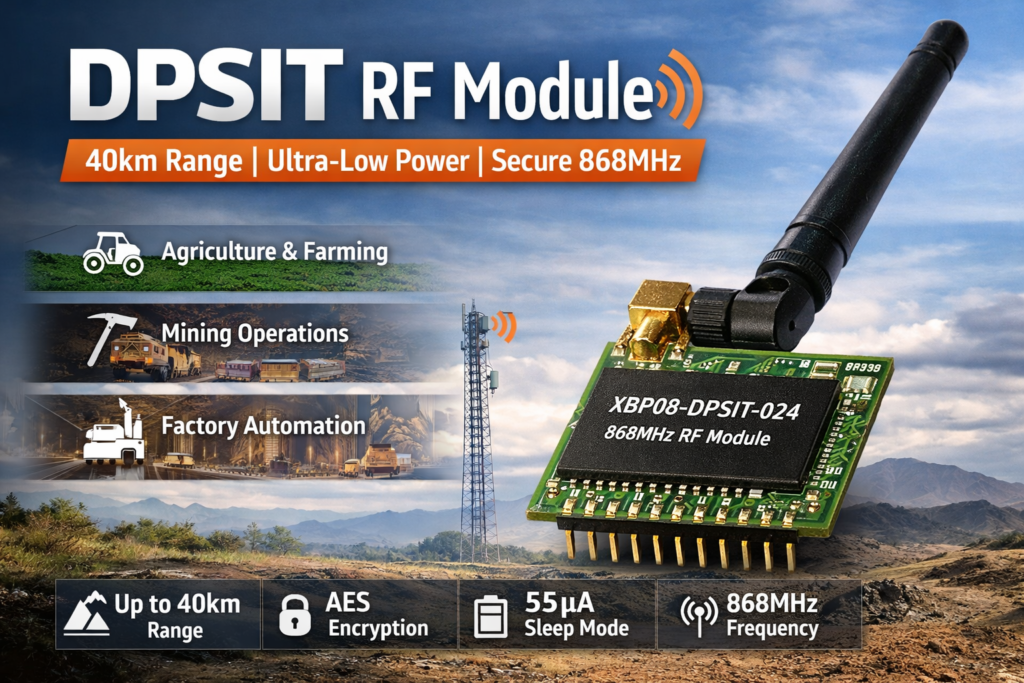
DPSIT is a long range Sub GHz RF module built for industrial and IoT communication. It is designed for projects where distance stability and low power consumption are critical. The module is officially known as XBP08 DPSIT 024. It operates on the 868MHz frequency band.
This compact device can transmit data up to 40km line of sight. It includes AES encryption for secure communication. Its ultra low sleep current makes it energy efficient. DPSIT is commonly used in agriculture mining and factory automation.
If you are comparing it with ZigBee Bluetooth or LoRa this guide helps you decide if it suits your needs.It offers secure 868MHz communication ultra low power consumption and reliable long range performance for demanding IoT and industrial environments.
What Is DPSIT
DPSIT Full Form and Product Identification
DPSIT refers to the XBP08 DPSIT 024 a high power 868MHz RF module built for long range wireless communication. Unlike short range 2.4GHz technologies this solution operates in the Sub GHz ISM band allowing stronger penetration and extended coverage.
Rather than being a framework or software platform, this particular model is a hardware communication module used in embedded systems and industrial IoT deployments.
Quick Definition
DPSIT is a compact 868MHz industrial RF module capable of transmitting data up to 40km line of sight offering 500mW transmit power 112dBm sensitivity AES encryption and ultra low power sleep mode for long range IoT applications.
Core Purpose of DPSIT
Its primary function is reliable long distance telemetry. This includes:
- Remote sensor monitoring
- Industrial machine communication
- Underground data transmission
- Agricultural field data collection
In environments where Wi Fi struggles and ZigBee fails to scale, this module maintains stable connectivity.
DPSIT Technical Specifications Complete Breakdown
RF & Communication Specs
The technical profile explains why it outperforms many short range competitors.
- Frequency 868MHz ISM band
- Range Up to 40km line of sight
- Transmit Power 500 mW EIRP
- Receiver Sensitivity112dBm
- Data Rate 24kbps
- Communication Mode AT and API support
Operating in the Sub GHz spectrum reduces interference compared to crowded 2.4GHz bands used by Bluetooth and ZigBee.
Power & Energy Performance
Energy efficiency is critical for remote deployments. In this regard DPSIT delivers:
- Supply voltage 3.0 3.6VDC
- Sleep current 55µA
- Optimized wake cycles for low power operation
Consequently battery powered sensor networks can operate for extended periods without frequent replacement.
Hardware & Interface
Physically the module is compact enough for embedded integration.
- Dimensions 32mm x 22mm
- 13 digital I O pins
- 6 ADC inputs
- PCB mountable
- RP SMA antenna compatibility
Because of its small footprint it fits well into custom boards for industrial systems.
Security Features
Security is non negotiable in industrial IoT.
- 128 bit AES encryption
- Secure data packet transmission
- Reduced risk of signal interception
This level of encryption aligns with modern industrial security expectations.
Environmental Tolerance
Unlike consumer grade devices it supports harsh conditions:
- Operating temperature -40°C to 85°C
- Designed for outdoor and industrial environments
This makes it suitable for mines farms and factories.
How DPSIT Works
Communication Architecture
Instead of using crowded 2.4GHz spectrum this module operates in the 868MHz band. Lower frequency signals travel farther and penetrate obstacles more effectively. Moreover Sub GHz propagation performs better in rural and industrial landscapes where interference is common.
Internal Data Flow
The communication cycle typically follows:
- Sensor data collection
- Structured transmission
- Secure packet encryption
- Reception at gateway
- Data logging or cloud integration
This streamlined approach ensures minimal packet loss and reliable long distance reporting.
Setup & Configuration
Configuration is straightforward:
- Mount on PCB
- Connect appropriate antenna
- Configure using AT commands or API mode
- Set transmit power and network parameters
Compared to complex mesh systems setup remains manageable for engineers familiar with RF modules.
DPSIT vs Other Wireless Technologies
DPSIT vs ZigBee
| Feature | DPSIT | ZigBee |
| Range | 40km | ~1km |
| Frequency | 868MHz | 2.4GHz |
| Power Efficiency | Ultra-low sleep | Moderate |
| Best Use | Long-range industrial | Short range indoor |
ZigBee excels in mesh networks but its limited range restricts large scale rural deployments.
DPSIT vs Bluetooth
Bluetooth prioritizes high data rate but sacrifices range. For industrial monitoring across kilometers it simply cannot compete.
DPSIT vs LoRaWAN
| Feature | DPSIT | LoRaWAN |
| Data Rate | 24kbps | Lower typical rates |
| Infrastructure | Direct RF | Gateway dependent |
| Latency | Lower | Often higher |
| Setup | Simpler | Network managed |
LoRaWAN works well for public network deployments. However DPSIT provides direct point to point control without dependency on third party networks.
Applications of DPSIT
Agriculture & Smart Farming
Farmers use it for:
- Soil moisture monitoring
- Irrigation control
- Vineyard climate tracking
For example large European vineyards deploy Sub GHz modules across hundreds of acres to transmit real time field data.
Industrial & Manufacturing
In factory automation it supports:
- Machine status monitoring
- Robotic system alerts
- Predictive maintenance systems
Because metal walls interfere with Wi Fi Sub GHz communication often performs better indoors.
Mining & Underground Operations
Underground environments block high frequency signals. The lower frequency of this module enables more reliable penetration. It supports:
- Tunnel structural monitoring
- Gas detection systems
- Worker safety alerts
Remote Telemetry
Utilities and infrastructure managers use it for:
- Water level monitoring
- Pipeline pressure tracking
- Remote energy meter reporting
Implementation Guide for Engineers
PCB Integration
Ensure proper grounding and antenna placement to avoid signal degradation.
Antenna Selection Guide
- Low gain antennas for short range
- High gain directional antennas for maximum distance
Improper antenna choice can significantly reduce performance.
Power Optimization
Configure sleep intervals carefully. Longer sleep durations extend battery life but reduce reporting frequency.
Common Mistakes
- Using incorrect voltage supply
- Poor antenna positioning
- Ignoring regional ISM regulations
Certifications & Compliance
Before deployment verify:
- CE compliance Europe
- FCC compliance if applicable regionally
- ISM band regulations
Consult official regulatory documentation from relevant authorities such as ETSI or FCC websites.
DPSIT Network Design Considerations
Maximum Node Capacity
Network size depends on architecture. Direct point to point setups differ from multi node networks.
Real World Range
Although 40km is line of sight terrain buildings and antenna gain affect performance.
Gateway Compatibility
It integrates with custom gateways or embedded controllers rather than public LoRa infrastructure.
Common Challenges & Limitations
- Lower data rate compared to Wi Fi
- Not ideal for high bandwidth applications
- Requires RF knowledge for optimal setup
Nevertheless for telemetry and control systems these limitations rarely present issues.
DPSIT Datasheet & Resources
Engineers should obtain the official datasheet for:
- Pin configuration
- Current consumption curves
- RF performance graphs
Link to official manufacturer documentation and related Sub GHz module guides for deeper technical analysis.
Conclusion
DPSIT stands out as a powerful Sub GHz RF module for long range communication. It is specifically built for industrial environments. The module supports up to 40km line of sight transmission. It uses AES encryption to keep data secure.
Its low power consumption makes it efficient for remote systems. Industries like agriculture mining and manufacturing benefit from its reliability. However it is not suitable for high bandwidth streaming tasks. Instead it performs best in telemetry and remote monitoring applications.
For projects that require stable long distance connectivity it is a strong and practical choice.For long distance secure and low power industrial communication DPSIT delivers reliable performance where other wireless modules fall short.
FAQs
What does DPSIT stand for?
DPSIT refers to the XBP08 DPSIT 024 RF module a long range 868MHz wireless communication device designed for industrial and IoT use.
What frequency does DPSIT operate on?
It operates in the 868MHz ISM band commonly used in Europe for industrial wireless communication.
Is DPSIT better than LoRa?
It depends on the use case. For private point to point industrial systems it offers simplicity and lower latency. For public wide area networks LoRaWAN may be preferable.
What is the real world range of DPSIT?
Although rated at 40km line of sight real world performance varies depending on terrain antenna gain and environmental interference.
Is DPSIT suitable for industrial IoT?
Yes. Its temperature tolerance encryption and low power consumption make it suitable for industrial IoT deployments.
Does DPSIT support mesh networking?
It primarily supports structured communication modes. Network design depends on implementation architecture rather than automatic mesh like ZigBee.